
Car Travel Trays for Kids: Foldable, Rigid and Multi-Pocket Designs Compared
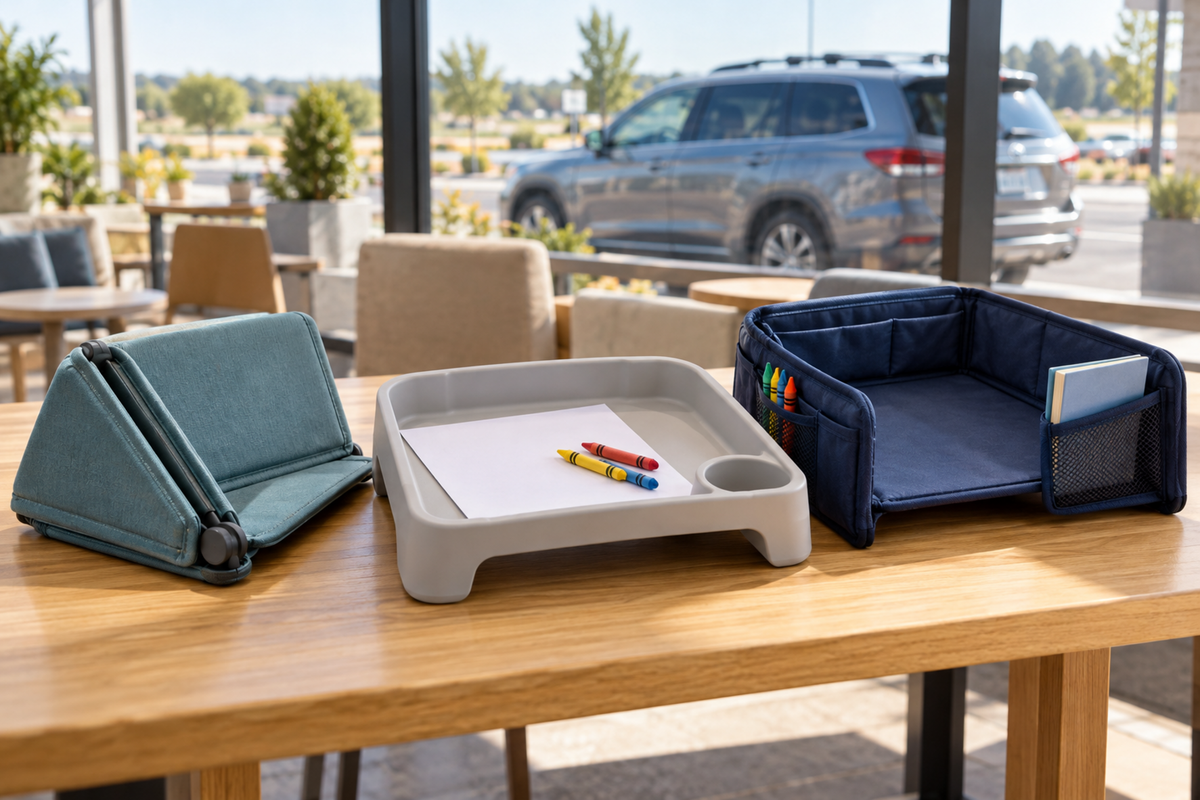
A coloring book sliding off a child's lap can turn a quiet travel activity into a repeated request for help. A travel tray promises a more organized surface, with room for paper, a few play materials, and perhaps pockets for keeping everything together.
However, the design labels can be misleading. Foldable describes how a tray packs away. Rigid describes how firmly it supports an activity. Multi-pocket describes its storage layout. One product can have all three characteristics.
The useful comparison is therefore not simply choosing between three separate categories. It is understanding how surface construction, folding points, storage, and attachment arrangements work together.
There is also an important distinction between an activity tray and an accessory approved for use with a particular child restraint. A product marketed for car travel is not automatically appropriate around every car seat or while the vehicle is moving.
This guide compares the practical features of foldable, rigid, and multi-pocket designs. It explains where each can help, what makes one frustrating, and how to choose an organizer without allowing convenience to interfere with correct restraint use.
Check the Intended Use Before Comparing Tray Features
A travel tray is an activity accessory, not a child restraint or a replacement for one. Its job is to provide a surface or storage, while the car seat, booster, or correctly fitted seat belt performs a different and essential function.
Start with the child-restraint and vehicle instructions. NHTSA advises against aftermarket car-seat products unless they are made or allowed by the original seat manufacturer for that product. A tray seller's claim of universal fit does not establish that permission. NHTSA
If compatibility for the intended use is not confirmed, reserve the tray for appropriate stationary activities and stow it securely before driving. A useful surface during a rest stop can still be worthwhile without being placed in front of a restrained child during travel.
Do not route tray straps through belt paths or around harness components unless the restraint manufacturer explicitly permits the arrangement. The tray must not change harness position, interfere with a buckle, or become a reason to loosen the restraint.
Likewise, do not change a child's required rear-facing or forward-facing arrangement to accommodate a desk. The restraint choice and installation come first. An accessory that does not fit within those requirements is the wrong accessory for that situation.
Soft padding, rounded corners, and fabric construction do not by themselves prove crash suitability. A padded product may still contain a rigid board, buckles, or other components. The complete design and its intended use matter.
Claims such as tested or child-friendly also need context. Ask what was tested and whether the information applies to the exact product and restraint arrangement. Photographs and customer reviews cannot establish compatibility on their own.
A tray used with a stroller or airplane table presents different requirements. Permission for one setting should not be assumed to transfer to another. Check the instructions for each piece of equipment.
Once those boundaries are clear, compare features for the uses that remain appropriate. The strongest practical choice may be a portable activity station for stops, accommodation, or other permitted settings rather than an accessory used continuously in the car.
This approach keeps the purchase realistic. You can still assess portability, surface quality, and organization while recognizing that the child's seating and restraint needs are not adjustable features of the tray.
Foldable Travel Trays: Easier Packing With More Moving Parts
Foldable trays are designed to become smaller when not in use. Some fold their side walls inward, some collapse along a center line, and others zip into a carrying shape. These arrangements can make storage easier between activities.
Their main advantage is portability. A tray that packs into a manageable shape may fit a bag or accommodation cupboard more conveniently than a large permanent lap desk. However, folded dimensions matter more than the word compact.
Check the thickness after folding as well as its width and length. Bulky pockets, handles, and fixed boards can leave a supposedly slim tray quite substantial. A carrying strap makes transport different, not necessarily smaller.
The folding mechanism affects the working surface. A central crease may create a ridge beneath paper, while a segmented base may bend when the child presses down. Some designs avoid this with a separate insert, but that adds another component.
For simple stickers or looking through a book during a suitable stationary activity, slight flexibility may be acceptable. For careful drawing or writing, the same movement can become frustrating. Match the surface to the intended task.
Side walls deserve a separate check. Fold-up borders may help contain some items, but they need enough support to remain upright. A wall that collapses under light contact may provide less containment than its height suggests.
Fasteners also influence setup. Zippers, hook-and-loop tabs, clips, and support flaps should be easy for the adult to operate and appropriate for the child. A complicated assembly can discourage use on short stops.
Fabric can become caught when the tray folds. If pockets remain full, pens, books, or other items may press against seams or prevent closure. Confirm whether the product is designed to fold with contents inside.
Foldability does not establish softness. A foldable model may include a firm internal panel, and a soft-looking exterior can conceal substantial structure. Inspect construction rather than inferring safety or comfort from appearance.
These trays suit families who value packing convenience and use the accessory in several appropriate settings. Their main compromise is the balance between compact storage and a consistently supportive surface. A design that folds neatly but requires constant reshaping may not provide the convenience you expected.
Rigid Travel Trays: Better Surface Support, Greater Storage Demands
A rigid tray provides a firm working area that resists bending under ordinary activity pressure. It may use molded plastic, a board enclosed in fabric, or another structured construction. Some rigid surfaces are part of foldable products.
The advantage is predictable support. Paper is less likely to sink between unsupported sections, and a book can remain flatter. This can make stationary drawing, puzzles, or similar permitted activities easier to organize.
Rigidity alone does not guarantee a level surface. A firm board can still tilt if its supports are uneven or if the child shifts position. Check how the complete design rests in its intended setting.
Surface texture matters too. A slick coating may clean easily but allow paper to slide. A textured surface may resist movement but make fine drawing less comfortable. A smooth removable mat can be useful only where the product supports that arrangement.
Raised edges can reduce the frequency of items rolling off during ordinary use. However, a high border can interfere with forearm movement or reduce the usable area. The headline dimensions may include space the child cannot actually work on.
Rounded profiles can improve everyday handling, but they should not be interpreted as evidence that a rigid object is appropriate in front of a child during a crash. Manufacturer permission and proper intended use remain separate questions.
Weight is another consideration. A substantial board may feel stable on a table but awkward to carry between stops. A smaller child may also need an adult to move it safely and comfortably.
Storage requires planning because the surface may retain its full footprint. A product that fits neatly on a hotel table may not fit the luggage compartment where you expected to keep it. Measure the stowed shape before buying.
Rigid designs can also be less forgiving when overpacked. A fixed cup recess or molded compartment may suit only certain container sizes. Do not force a bottle or object into an opening simply because the product includes one.
Choose rigidity when a firm activity surface is a clear priority in an appropriate setting. Its value comes from support and predictability. It should not become a reason to overlook bulk, weight, compatibility, or the difficulty of securing it when it is not in use.
Multi-Pocket Designs: Useful Organization or Unnecessary Clutter?
Multi-pocket trays combine a surface with storage along the sides, back, or lower edge. They can reduce the number of separate bags needed during an activity, but pocket count alone does not establish usefulness.
The best layout gives the child access to a small, suitable selection without constant adult assistance. A few visible compartments may work better than many narrow pockets that hide items or become difficult to empty.
Consider reach. A pocket hanging below the surface may look convenient in a product photograph but be hard to access from the child's actual position. Do not encourage leaning away from a correctly fitted restraint to retrieve something.
Handedness can affect the arrangement. A large pocket or raised holder beside the drawing hand may obstruct movement. Removable or repositionable organizers can help where they are designed for that purpose.
Pocket depth creates another trade-off. Shallow compartments make contents easy to see but may retain them poorly. Deep compartments can contain items more effectively while making smaller objects difficult to retrieve.
Mesh improves visibility but can catch narrow objects or collect crumbs. Solid fabric hides contents and may be harder to inspect. Neither material is automatically better; choose according to what you intend to store and clean.
Storage should not become an invitation to overload the tray. Heavy items can distort hanging pockets, change balance, and make carrying awkward. A tray's compartment is not automatically an appropriate transport restraint for its contents.
Tablet holders require particular caution. A sleeve that supports a screen during a stationary activity is not necessarily a crash-tested vehicle mount. Do not assume a product photograph establishes safe placement during driving.
The contents also need to suit the child's age and the setting. Small pieces, magnets, button batteries, sharp tools, and unsuitable cords introduce concerns that a pocket does not solve. Choose activities according to appropriate toy guidance.
A simple activity kit can be more useful than filling every compartment. Store a manageable book or suitable materials, keep spares elsewhere, and rotate activities when stopped. This reduces rummaging and makes cleanup easier.
Multi-pocket designs work best when organization is the real problem. If a child mainly needs a flat surface for one activity, additional compartments may add bulk without much benefit. Buy the layout for the items you actually use, not for the largest number of pockets.
Size, Comfort, Cleanup, and the Reality of Family Use
A tray should fit the intended space without forcing the child into an awkward position. Width affects clearance, depth affects reach, and border height affects arm movement. A large surface can become inconvenient if its far edge is difficult to use.
Test the product in the appropriate stationary setting before a trip. Check that the child can see the activity, move comfortably, and return items without strained reaching. Do not use this test as a substitute for restraint compatibility.
Consider whether the tray encourages prolonged looking downward. Reading or focusing on a close activity during vehicle movement can worsen motion sickness for some children. A desk is not a guaranteed solution to travel discomfort. Mayo Clinic
If a child becomes uncomfortable, stop the activity and respond appropriately. Listening, conversation, and other suitable travel options may work better. Do not turn a child's preference for looking outside into a failure to appreciate the accessory.
Snacks deserve separate planning. Eating while a vehicle is moving can make supervision and response more difficult, especially for young children. Plan food breaks with the vehicle safely parked and the child appropriately supervised rather than treating a tray as permission for continuous eating.
Cleaning requirements vary. A wipe-clean top may still have absorbent seams, fabric walls, and pockets. Waterproof marketing can describe only part of the product rather than every joint and internal layer.
Check whether covers or inserts can be removed and whether machine washing is explicitly permitted. A hidden board may warp or retain moisture if soaked. Follow the instructions rather than assuming a fabric exterior means the entire tray is washable.
Crumbs and residue collect where surfaces meet raised borders. Deep corners and stitched seams may need more attention than a flat panel. Assess those areas before purchase, particularly if the tray will be used for food during stops.
Let the product dry fully before folding and storing it. Closing a damp tray around papers or fabric accessories can create odors and make cleaning harder. Empty pockets so forgotten items do not remain trapped between sessions.
Inspect hinges, seams, fasteners, and internal panels periodically. Stop using a product with exposed sharp components or damage affecting its intended function. A worn covering should not conceal a broken support.
The most practical design is one that fits your routine after the first outing. Easy setup, predictable cleanup, and manageable storage often matter more than a long list of features that become difficult to maintain.
Choosing a Tray Without Expecting It to Solve Every Journey
Begin with the intended activity and setting. A portable surface for rest stops or accommodation has different requirements from an accessory someone hopes to use around a child restraint. Confirm permitted use before comparing extras.
For packing convenience, look closely at a foldable model's actual stowed dimensions and setup sequence. For a dependable stationary work surface, assess rigidity, usable area, and stability. For organization, examine the position and size of the pockets.
Remember that these features can coexist. A foldable tray can have a rigid center and several compartments. The best choice may combine selected characteristics rather than belong neatly to one category.
A cardboard size template can help you understand dimensions before ordering, but it cannot establish safety or compatibility. Use it only to visualize storage and the working area. The actual product's materials, internal structure, attachments, and instructions still need assessment once you have the complete information available beforehand.
Avoid buying solely according to age ranges in advertising. Children's reach, interests, body size, and equipment differ. A product that suits one child may be too large, distracting, or awkward for another.
Try a small, practical activity setup before adding numerous accessories. Observe whether the child uses the surface comfortably and whether the pockets reduce requests for help. If the tray creates more setup work than useful activity, a simpler arrangement may be better.
No tray guarantees a quiet trip or removes the need for breaks. Children may prefer conversation, looking outside, listening, or changing activities. An organizer should support a useful option rather than become an expectation to remain occupied continuously.
Secure the tray and its contents appropriately when they are not being used. An empty product still needs proper storage; folding it does not automatically prevent it moving inside the vehicle.
Do not adjust straps, retrieve dropped items, or reorganize a child's workspace while driving. Set up during stops and keep the driver's attention on the road. If something falls, waiting until a safe opportunity is usually the practical answer.
A good purchase should earn its place through repeated appropriate use. Consider whether it works during stops, at your destination, and in the storage space available. Multiple useful settings can provide value without assuming universal compatibility.
Foldable, rigid, and multi-pocket designs solve different problems: portability, surface support, and organization. Choose the features you genuinely need, respect the instructions for every piece of equipment involved, and keep correct child restraint use ahead of convenience.